
Free e-book
Your body is unique
Why it doesn’t react like other people’s, and how to take that into account every day
6 chapters29 min read16 sources
- Nutrition
- Physical activity
- Sleep
- Mental well-being
Contents
- IntroWhy doesn’t what works for others always work for you?3 min
- 01What if the problem isn’t where you think it is?4 min
- 02Your body changes. Your strategy should evolve too.4 min
- 03How much do we really know about our bodies?6 min
- 04I know what I need to do. So why is it so hard to do it?5 min
- 05Your own starting point: from understanding to action4 min
- 06What if you didn’t have to do it all on your own?3 min
- AppendixBibliography
Introduction
Why doesn’t what works for others always work for you?
Why can your partner have a coffee in the middle of the afternoon and sleep without any trouble, while it keeps you awake? Why can two people who eat in a similar way, or follow the same training programme, get such different results? And why, over the years, does your body seem to respond differently even though your habits have barely changed?
There is also the opposite question: if you feel good today, what can you do to keep feeling good in ten or twenty years’ time?

We are surrounded by advice on how to take care of ourselves. We know it is wise to eat a balanced diet, stay active, get enough rest and look after our mental well-being. These principles are backed by science and form a valuable foundation for almost everyone. Yet general recommendations don’t always tell us how to apply them to our own situation.
We don’t have the same body composition, the same genetic predispositions or the same personal history. Nor do we live in identical circumstances or pursue the same goals: while one person wants to lose fat without sacrificing muscle, another wants to perform better at sport, get their energy back or stay independent as they get older. Even our own needs evolve over time.
That’s why it may not be enough to ask ourselves, “What is healthy?” Another question is worth adding: what do I personally need, at this point in my life, to achieve what really matters to me?
Science today has tools that make it possible to explore certain aspects of our biology, better understand our habits and follow how certain biological indicators change. But getting information is not the same as knowing how to use it. The challenge is to work out what is relevant for each person and turn that knowledge into decisions that fit into their everyday life.
In this guide, we’ll explore why our responses can differ, how factors we usually consider separately are connected, and what we can learn from our bodies to look after ourselves in a more personal, mindful and practical way.
Your well-being is personal. The way you look after it must be too.
Did you know?
Two people eat exactly the same meal. Do their glucose levels respond in the same way?
The same meal can trigger very different responses.
800people, with a glucose sensorfor one week
47,000meals: the same dish, very different responses from one person to the next
A model later tested on other people
In 2015, a team of Israeli researchers studied 800 people for a week. They used sensors that continuously measured their glucose levels and recorded the body’s responses to nearly 47,000 meals [1].
They found something surprising: in response to the same meal, some people saw a large rise in their glucose levels, while in others the rise was much smaller.
The researchers also analysed the participants’ habits, physical characteristics, blood tests and gut microbiota. By combining this information, they developed a model able to predict individual responses, then tested it on other people.
What does this study teach us? That knowing the nutrients in a food matters, but it isn’t always enough to anticipate how our body will respond. Our individual characteristics can play a part too.
Source: Zeevi et al., 2015 [1]
Chapter 1· 4 min
What if the problem isn’t where you think it is?
Imagine you want to lose weight and decide to pay more attention to what you eat. You add vegetables to your meals, cut down on ultra-processed foods and try to adjust your portions. During the day, everything seems to be going well, but in the evening you get home hungry, tired and not much in the mood to cook; you end up snacking more than you meant to, and the next day you blame yourself for not having had enough willpower.
A trial on sleep
- 80adults with overweight who slept less than 6 h 30 a night; half were given advice to sleep more, with no diet or exercise imposed
- +1 h 12more sleep a night, on average
- ≈ 270 kcalless a day than the group without advice, with no instruction to eat less
Source: Tasali et al., 2022 [2]
The conclusion seems obvious: you need to keep better control of what you eat. But there is another question you may not have asked yourself: how are you sleeping?
What they found by changing sleep, not diet
In 2022, researchers at the University of Chicago published a clinical trial involving 80 overweight adults who usually slept less than six and a half hours a night [2]. Some of the participants were offered guidance on extending their sleep; the others carried on with their usual habits. No diet or exercise programme was prescribed, and everyone went on living at home throughout the two weeks of the intervention, which were preceded by two weeks of observation.
Those who received the guidance slept, on average, about an hour and twelve minutes longer each night. Compared with the control group, they consumed around 270 fewer kilocalories a day, again on average, even though they had not been told to eat less.
We can’t conclude that sleeping more will have this effect on everyone: the trial was short and was carried out in a specific group. What is interesting is the connection it reveals. An intervention focused on sleep went hand in hand with changes in eating, an area that had not been addressed directly.
The connections we don’t always see
We tend to divide our well-being into compartments: if we want to lose weight, we think about diet; if we’re tired, we reach for coffee; if we want to get fit, we consider doing more exercise. Our bodies, however, don’t work in separate departments: everything is connected.
Too little sleep can affect appetite and concentration; physical activity can support rest and psychological well-being; and stress can change both our schedules and the choices we make about eating and moving. Nutrition, physical activity, sleep and mental well-being thus form four pillars that are worth looking at together, without assuming that each one has the same influence on everyone.
- Nutrition
- Physical activity
- Sleep
- Mental well-being
Did you know?
You have a strong coffee in the afternoon. Up to how many hours before bed can it still eat into your sleep?
Caffeine can disrupt your sleep even six hours after you have it.
6h
12 adults · 400 mg of caffeine
In 2013, American researchers carried out an experiment with 12 adults to find out how much the time at which they had caffeine affected their sleep [3].
The participants were given 400 mg of caffeine in capsules (a high dose, equivalent to several coffees depending on how they are made) just before going to bed, three hours before or six hours before. They also did a test with a placebo.
The result was surprising: even when they had taken the caffeine six hours before going to bed, objective measurements showed that they slept a little over an hour less than with the placebo, although the participants did not clearly notice it in their sleep diaries.
This means that a substance we consume to stay awake during the day can go on interfering with our sleep long after we’ve had it. And because sensitivity to caffeine and the speed at which the body clears it vary from person to person, we don’t all feel its effects in the same way.
Source: Drake et al., 2013 [3]
In the opening example, looking again at what you eat could be useful, but the lack of sleep, the way activity is spread across the day, or the circumstances that make certain habits hard to keep up may also deserve attention. For someone whose goal is to perform better at sport or get their energy back, the priorities could be different.
The lesson is not that we should change everything at once, but that sometimes the best way to move towards a goal is to pay attention to a factor we hadn’t yet considered.
There is another reason to review our strategies: we ourselves change over time. What we need today may be different from what suited us ten years ago.
Chapter 2· 4 min
Your body changes. Your strategy should evolve too.
Imagine Mark, who has weighed practically the same for years. His clothes are still the same size and the scales barely move, so at first glance it seems that nothing has changed. But what if his body were different, even though he still weighs the same?
What the studies show
- More muscle, less strengthIn men followed for nearly ten years from the age of 45 to 49, muscle mass had increased slightly, but strength and power had decreased.
- The scales don’t tell the whole storyDuring the menopause transition, fat mass rose faster and lean mass fell, without weight reflecting it as much (1,246 women followed).
What we don’t see changes too
In 2014, Belgian researchers published a study in which they followed a group of men aged 45 to 49 for almost ten years [4]. They noticed something striking: although their muscle mass had increased slightly over that time, their muscle strength and power had decreased. They had a little more muscle, but that muscle produced less strength and power.
This result suggests that the amount of muscle doesn’t explain everything: its ability to generate strength and meet the demands of our everyday lives matters too.
That’s why looking after our muscles as we get older isn’t only about keeping muscle mass, but also about maintaining the strength and physical capacity that allow us to keep doing the things we want to do.
Weight doesn’t tell the whole story either
In women, the American SWAN study identified a different but equally revealing phenomenon. The researchers followed 1,246 women for years to observe how their body composition changed during the transition to menopause [5].
During this stage, they observed that body fat began to increase more quickly, while lean mass decreased. Yet these changes were not reflected in the same way in total weight: on average, weight kept rising at the same pace as before, without speeding up. On their own, the scales could not show this change in body composition.
- Weightthe number on the scales
- Body compositionthe share of fat mass and lean mass
- Physical capacitiesstrength and mobility in everyday life
Not every woman goes through the same changes, but these results show that one of the indicators we check most often, weight, gives an incomplete picture of our body.
Beyond the kilos
Both studies point to an essential distinction: our weight, our body composition and our physical abilities are not the same thing. If we want to lose weight, it’s worth paying attention not only to the kilos we lose, but also to how we preserve muscle mass. If we want to stay active over the years, keeping our strength and mobility may matter more than maintaining a particular number on the scales.
Our priorities change too. At 30, we may want to improve our sporting performance; at 60, to keep the energy and strength to go on doing what we enjoy. And there’s no need to wait for a problem to appear: looking after ourselves also means preserving the independence and abilities we want to keep for many years.
Did you know?
Where does the famous figure of 10,000 steps a day come from?
Do we really need to walk 10,000 steps a day?
10,000steps a day
The pedometer figure
Under 608,000 to 10,000
60 and over6,000 to 8,000
You’ve probably heard many times that we should walk 10,000 steps a day to stay in good shape. But where does that figure come from? Curiously, it most probably comes from the brand name of a Japanese pedometer launched in 1965, the Manpo-kei (“10,000-step meter”), and not from a scientific recommendation that had established that number as ideal [6].
In 2022, an international team analysed the results of 15 studies involving 47,471 adults [7]. The researchers observed that walking more was associated with a lower risk of mortality, but they found something interesting: the reduction in risk did not keep increasing at the same rate indefinitely, and the number of steps associated with the lowest risk varied with age.
These were the approximate ranges beyond which the reduction in risk tended to level off. They are not compulsory targets, nor do they ensure a result for any individual.
The conclusion? There is no magic number that works for everyone. What matters is to move regularly and find a target suited to our age, physical capacity and starting point. Increasing the number of steps could be beneficial, especially for people who don’t walk much.
Source: Paluch et al., 2022 [7]
Is your plan from ten years ago still right for you?
Sometimes we stick with strategies that worked for us at another stage of life without asking whether they still meet our needs. It isn’t about constantly reinventing our habits, but about checking from time to time where we are, what we want to achieve and whether what we are doing still works in our current circumstances.
Taking good care of ourselves isn’t about trying to hold on to the body we had ten years ago, but about giving it what it needs to live better today and keep our abilities tomorrow.
To do that, there is a question worth exploring: what can we really know about our bodies, and what information would help us make better decisions?
Chapter 3· 6 min
How much do we really know about our bodies?
You have probably run into someone after many years and thought, “It’s as if time hasn’t touched them!” Or perhaps you’ve been surprised that a former classmate looks a good deal older than they are. Appearance depends on many factors and doesn’t, on its own, reveal how the body is ageing, but that difference raises a fascinating question: can we study ageing beyond what we see in the mirror?
Key ideas
- Chronological ageAge by the calendar: the number of years since birth.
- EpigeneticsThe mechanisms that regulate gene activity without changing the DNA sequence.
- Epigenetic clockA tool that analyses epigenetic markers that change with age, to estimate some aspects of biological ageing.
Source: Horvath, 2013 [8]
How old is our body, really?
We all know our chronological age: the number of years since we were born. But our bodies go through biological changes that don’t always move at the same pace as the calendar, nor happen in the same way in everyone.
Epigenetics is the study of mechanisms that regulate the activity of our genes without changing the DNA sequence. Some of these signals change with age and have made it possible to develop what are known as epigenetic clocks, which analyse molecular patterns to estimate certain aspects of biological ageing [8].
What is interesting is that our habits can also leave their mark on these signals. Various observational studies, for example, have linked smoking to an acceleration of some epigenetic clocks, while more physical activity has been associated with slower epigenetic ageing according to some of them [9, 10]. These links don’t mean that a test can tell us exactly how long we will live, or that exercise automatically takes years off our biological clock, but they do make it possible to study how certain behaviours are associated with processes related to ageing.
Did you know?
Identical twins have the same DNA. Are their genes always regulated in the same way?
Identical twins can have the same DNA, yet develop epigenetic differences over the years.
Younger twins
Older twins
In 2005, an international team led from the CNIO in Madrid studied 40 pairs of Spanish identical twins aged between 3 and 74 [11].
Identical twins share practically the same genetic information. Yet the researchers discovered something fascinating: while the youngest pairs had very similar epigenetic patterns, considerable differences could be seen among the older ones.
These differences involved chemical modifications linked to the regulation of gene activity. They were also more pronounced in twins who had spent less time living together and had different lifestyles.
What does this study teach us? That sharing the same genes doesn’t mean their activity will always be regulated in the same way. Over the course of our lives, environmental factors, our habits and the biological processes of ageing themselves can all contribute to our epigenetic profiles evolving differently.
Source: Fraga et al., 2005 [11]
Our chronological age moves forward inevitably, but some biological processes related to ageing are associated with our habits. Exercise, diet and exposure to tobacco are among the factors studied for their relationship with epigenetic mechanisms. Epigenetics thus offers us a different perspective on how we age. And it is just one of the pieces that can help us understand our bodies better.
The puzzle of our body
We can picture what we know about our body as a large jigsaw puzzle: each piece sheds light on a different aspect of it and, by connecting the pieces, we begin to understand the whole better.
One of these pieces lies in our genes, which hold information about certain individual predispositions, including some related to nutrient metabolism.
For example, we know that vitamin D plays important roles in the body and that its levels depend on various factors, such as diet and sun exposure. But we may not know that certain genetic variants have also been associated with differences in its concentration in the blood [12].
Genetic information of this kind can provide an additional clue that we didn’t have before. On its own, it can’t be used to calculate our individual needs or to determine a supplement dose, but it can help us better understand our profile when we interpret it alongside our circumstances and, where appropriate, a blood test.
Another piece is the gut microbiota, the community of microorganisms that lives with us and plays a part in processes related to digestion, metabolism and the immune system. Current techniques make it possible to study its composition, its diversity and part of its functional potential; we also know that this ecosystem can change with diet and other factors.
Fibre offers a concrete example. A systematic review and meta-analysis of 64 trials in healthy adults observed that fibre, particularly fructans and galacto-oligosaccharides, increased the presence of bifidobacteria and lactobacilli in stools, without changing the overall diversity of the microbiota [13].
This finding shows us that the microbiota is not a fixed characteristic, but an ecosystem that interacts with our habits. Studying it can provide complementary information, although we are still learning which results are genuinely useful for guiding individual decisions.
Blood tests, body composition, family history and our personal circumstances also add to the puzzle.
The pieces of the puzzle
Tap each piece to see what it can tell you.
No piece is enough on its own: the value lies in connecting them.
Imagine two people who want to improve their energy levels. One sleeps little and keeps irregular hours; the other gets enough rest but feels persistently tired. Even though they share the same goal, the information we need to explore and the steps worth considering may be different.
That is the value of connecting the pieces: not simply having more data, but discovering which of it can help us better understand our own situation.
From photograph to film
One detail makes this puzzle even more interesting: many of its pieces change over time. Our genetic sequence remains essentially stable, but body composition, the microbiota, certain biological indicators and, of course, our habits and goals can all change.
An initial assessment is like a photograph of our starting point. To see what happens next, we need something more like a film: observations made over time that allow us to recognise trends and check whether the strategy is still right.
Smartwatches and other connected devices can contribute to this tracking by recording physical activity, sleep or heart rate, bearing in mind that not all their measurements are equally accurate. Blood tests and other assessments, when justified, make it possible to observe changes in various indicators. This information becomes meaningful when we relate it to our goals. If we want to improve our fitness, for example, we might want to look at how our strength or our ability to do certain activities changes, as well as changes in our weight.
Tracking isn’t about watching every number or putting every change down to a single cause. Its value lies in observing, learning and adapting: recognising what we are achieving, which circumstances have changed and which adjustments are worth making.
Knowing in order to act
Today we have more ways than ever to explore different aspects of our biology. Yet the real value of this knowledge doesn’t lie in piling up tests and results, but in discovering which information is relevant to us and how we can use it.
A new piece of the puzzle can help us better understand a characteristic of our body, ask ourselves a question we hadn’t considered or rethink a strategy we assumed was right.
But even when we understand our needs and know what we want to achieve, there remains a challenge we all know well: putting that knowledge into practice.
Why is it so hard to turn what we know into habits that last?
Chapter 4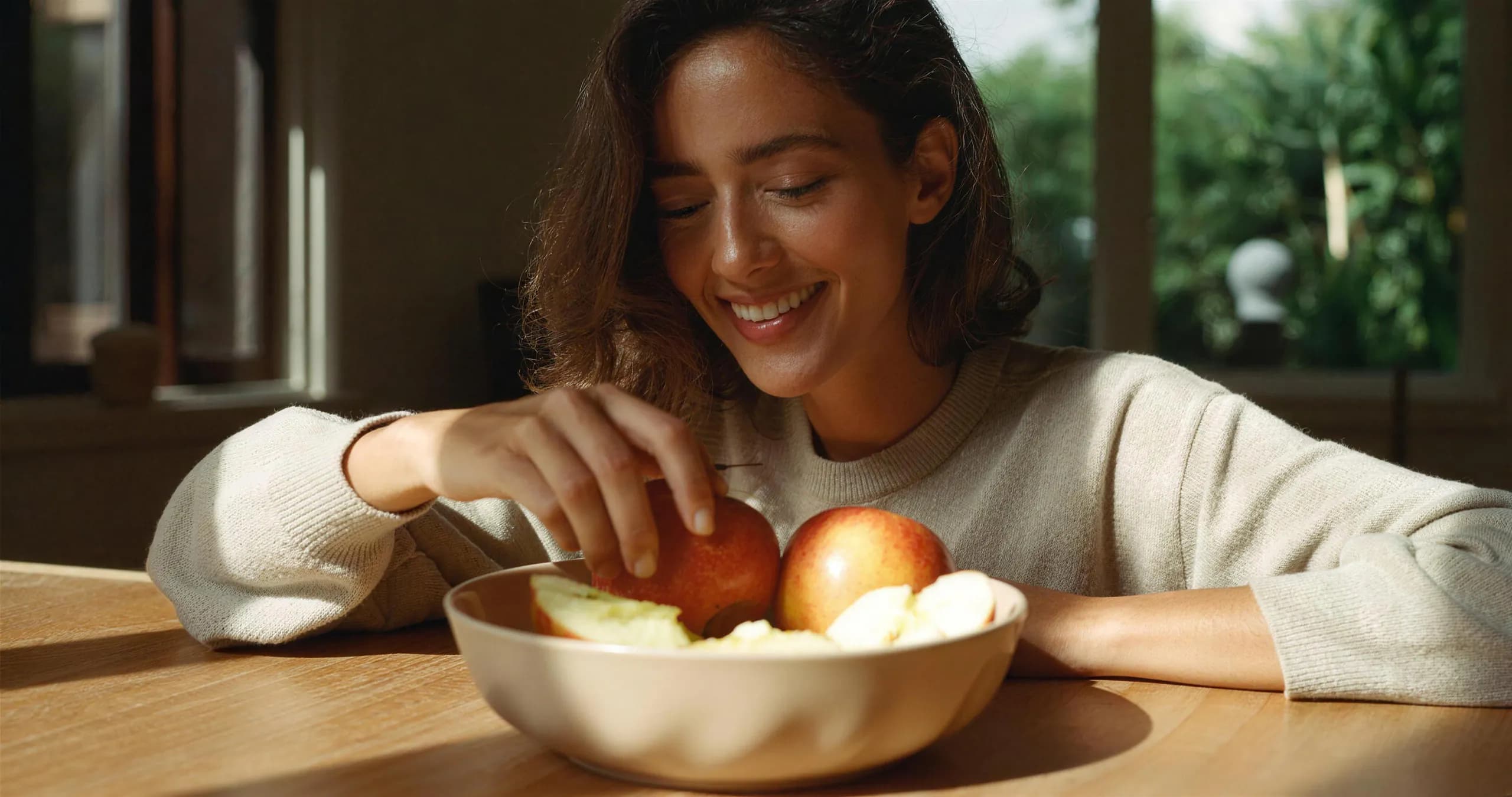
Chapter 4· 5 min
I know what I need to do. So why is it so hard to do it?
On Sunday afternoon, everything seems simple. You’ve decided to eat better, get back into your exercise routine and start going to bed earlier. You plan the week enthusiastically and you’re clear about what you want to achieve.
Key ideas
- “If… then” planningDeciding in advance what we will do in a specific situation: if this situation arises, then I will do this.
- What the research saysIn a meta-analysis of 94 independent comparisons, this kind of plan clearly increased the likelihood of reaching one’s goals, without guaranteeing success.
- HabitIt is built through repetition. Missing a single opportunity doesn’t necessarily undo the progress.
Source: Gollwitzer & Sheeran, 2006, Lally et al., 2010 [14, 15]
Then Thursday comes. You’ve had a difficult day, you leave work late and there are still things to sort out. The gym can wait, making a balanced dinner takes energy you no longer have and, when you finally sit down on the sofa, the last thing you feel like doing is switching off the television to go to bed.
You haven’t changed your mind about how important it is to look after yourself. Nor have you forgotten what is good for you. It’s simply that, between your intentions and your everyday life, obstacles have appeared that you hadn’t counted on.
It is a far more common situation than we think. And there is an interesting explanation for it.
Motivation isn’t always enough
We tend to put our difficulty in keeping up good habits down to a lack of willpower. But our decisions also depend on tiredness, the time available, our routines, our surroundings and how easy it is to carry out an action.
Let’s take something as simple as eating fruit. If we have a fruit bowl in plain sight, it is probably easier to pick a piece than if we have to dig it out from the back of the fridge, wash it and prepare it when we’re in a hurry.
The intention is the same, but the circumstances favour one decision over the other. That’s why, to change our habits, it is sometimes more effective to make decisions easier than to keep demanding more discipline of ourselves.
What science has discovered about good intentions
Researchers in behavioural psychology have spent decades studying why our resolutions don’t always turn into actions.
One of the best-studied strategies is to decide in advance what we will do in a specific situation, rather than trusting that we’ll find the right moment and motivation. It is known as “if… then” planning.
For example, instead of simply telling ourselves “I’m going to walk more”, we can decide: “If I finish lunch and have ten minutes free, I’ll go for a walk before going back to work.”
The difference seems small, but it isn’t. In the second case, we have already linked a recognisable situation to a specific action, reducing the need to make a new decision when the moment comes.
In a meta-analysis that brought together 94 independent comparisons, researchers observed that this type of planning had a positive effect, medium to large in size, on reaching the goals people had set themselves [14].
It doesn’t ensure success or remove every obstacle, but it shows that the way we organise our intentions can be as important as the intention itself.
“If… then” planning
A goal
“I’m going to walk more.”
A decision made in advance
- If
- I finish lunch and have ten minutes free,
- then
- I’ll go for a walk before going back to work.
Write your own “if… then”
Choose a situation that comes up regularly in your week, and the action you’ll take when it does.
If I finish lunch and have ten minutes free, then I’ll go for a walk before going back to work.
Saved on this device only.
Did you know?
You spend hours sitting down. Is there any point in getting up to walk for a few minutes now and then?
Getting up to walk for a few minutes every 20 or 30 minutes can dampen the rise in glucose after meals.
One hour of sitting
2 min of walking every 20 min
5 min of walking every 30 min
We spend many hours sitting down: working at the computer, attending meetings or watching television. But what happens if we break up those periods with short walks?
In 2022, a team of researchers reviewed seven one-day laboratory trials, mostly in overweight adults, comparing the effects of sitting for long periods with standing up or taking short walks [16].
The results showed that breaking up sitting time with gentle walks reduced the glucose and insulin response after meals, compared with sitting continuously. Walking also had a greater effect on glucose than simply standing.
This doesn’t mean there is an ideal frequency for everyone, or that these walks replace regular exercise. But it does remind us that building small movements into our routine can have benefits, even when we don’t have time to train.
Source: Buffey et al., 2022 [16]
The best plan is the one that fits your life
There is another common mistake: designing our goals around an ideal week, rather than around the week we actually live.
A training plan can be excellent on paper but of little use if it demands five sessions a week from someone who barely has time for two. A perfectly planned diet won’t be much help either if it means cooking every night when we know we get home exhausted.
On paper
5 sessions planned a week
In your week
time for only 2
Personalising a strategy isn’t only about adapting it to our biology or our goals. It also means taking into account our schedules, responsibilities, preferences and resources. And that includes accepting that some weeks will be better than others.
Habits are built through repetition, but they don’t require perfect execution. Research on habit formation has observed that missing a single occasion does not necessarily undo the progress made [15]. What matters is being able to pick the behaviour up again and keep it going.
Consistency doesn’t mean always getting everything right, but finding a way to keep going even when circumstances change.
Looking after yourself should get easier, not more complicated
We can know what is good for us and still face difficult decisions every day: what to eat, when to move or how to rest when our commitments pile up.
Rather than adding another list of demands, we need to identify what matters and find realistic ways to put it into practice.
And now that we better understand why knowledge doesn’t always turn into action, we can ask ourselves where to begin.

Chapter 5· 4 min
Your own starting point: from understanding to action
By now we know that our well-being depends on many factors, that our needs change and that it isn’t always easy to turn good intentions into lasting habits.
But how do we bring all this into our lives without making things even more complicated?
The answer isn’t to draw up an endless list of things we should improve. It’s about finding a starting point, choosing actions that make sense for us and seeing what happens.
Let’s do it in five steps.
1Define what you want to achieve
The first step is to choose a priority and turn it into a concrete goal.
Instead of “I want to get fit”, you could aim for “I want to build strength so I can get back to my favourite sport”. Or change “I want to take better care of myself” to “I want to improve my diet and my physical activity to have more energy in my daily life”.
The clearer you are about what you want to achieve, the easier it will be to work out where to start and to assess your progress.
2Understand your starting point
Once you’ve defined your goal, the next step is to better understand your current situation.
Remember the puzzle of our body? Even when pieces are missing, we can get a fairly good idea of the picture. But some details remain hidden, and a new piece can help us not only to complete the image, but also to see what we already knew in a different light.
Something similar happens with our bodies. Our habits, personal history, body composition and blood tests give us valuable information about our starting point. Genetic, microbiota or biological ageing analyses can add new perspectives and reveal individual characteristics that aren’t obvious at first sight.
The point isn’t to have as much data as possible, but to understand how it fits together and which of it may be relevant to our goals. The better we know our starting point, the more we have to go on in building a strategy suited to our needs.
3Choose actions tailored to you
Now it’s time to move from knowledge to action.
Information about our body, our habits and our goals can help us identify which areas are worth working on. But a good strategy must also take our time, preferences and circumstances into account.
Instead of simply aiming to “do more exercise”, you might start by walking for fifteen minutes after lunch three days a week. If your priority is to rest better, you could begin by getting up at a more regular time.
We’re not looking for the most spectacular change, but for one that makes sense for our goal and that we can build into our routine.
Think too about what might get in the way and how you can prepare for it. The fewer decisions you have to improvise at the last minute, the easier it will be to put into practice.
4Observe your progress
After a few days or weeks, depending on the goal, take a moment to review how you’re getting on.
Have you been able to keep up the changes? How have you felt? Have you come across any difficulty you hadn’t foreseen?
You can draw on your own observations, simple records, connected devices and, where appropriate, certain biological indicators.
Not all changes happen at the same pace. Some habits can be assessed within a few days, while certain physical or biological adaptations take weeks or months to show.
What matters is to look at trends and assess whether you’re moving towards your goals, without expecting immediate transformations.
5Learn and adjust your strategy
You may find that the actions you chose fit perfectly into your routine. Or you may need to change the timing, adjust the frequency or consider alternatives.
Tracking helps you understand what is working, what difficulties are coming up and what is worth adapting.
Over time, your needs, your priorities and your circumstances may change too. That’s why a personalised strategy shouldn’t be a rigid plan, but a process of learning and evolving.
- Understand
- Act
- Observe
- Adapt
Understand, act, observe and adapt: a process that can stay with you throughout your life.
Now it’s your turn
Your first step starts today
Before you go on, take a moment to think about your current situation. You don’t need to design a perfect plan: the aim is to identify what you want to achieve, what information could help you and where you’d like to start.
Keep your answers. You can come back to them later to see what has changed and whether your priorities are still the same.
Your answers are saved on this device only: they aren’t sent anywhere.
You don’t need to design a perfect plan from day one. What matters is to start with a clear direction and use what you learn along the way to improve your strategy.
What if you didn’t have to gather and interpret all the information on your own, decide what to do every day and adjust your strategy without help?
That’s the next step: finding a way to turn what you’ve learnt into something you can keep up.
Chapter 6
Chapter 6· 3 min
What if you didn’t have to do it all on your own?
We have never had so much information about how to look after ourselves. Every day we come across new advice on eating, exercise, sleep or ageing, but it isn’t always easy to tell which is grounded in science, which simply follows a trend and which is really right for us.
What Genio brings together
- Your habits
- Your goals
- Your biological tests
- Data from your connected devices
Only the information you choose to share.
Sometimes the recommendations even seem contradictory. What one source advises, another advises against, and we end up not knowing who to listen to or where to start.
Throughout this guide, we’ve discovered that our well-being depends on many factors and that each person has different characteristics, circumstances and goals. We’ve also seen that science offers tools to help us know ourselves better. But having information doesn’t necessarily mean knowing how to interpret it or turn it into useful decisions.
What if you could rely on a solution that helped you pick out what matters, connect the pieces of the puzzle and turn that knowledge into actions tailored to you?
How Genio was born
Genio was born from a simple idea: well-being should be as personal as each of us.
Our platform combines scientific knowledge, artificial intelligence and human support to help you better understand your starting point, identify your priorities and build a strategy tailored to your goals and your life.
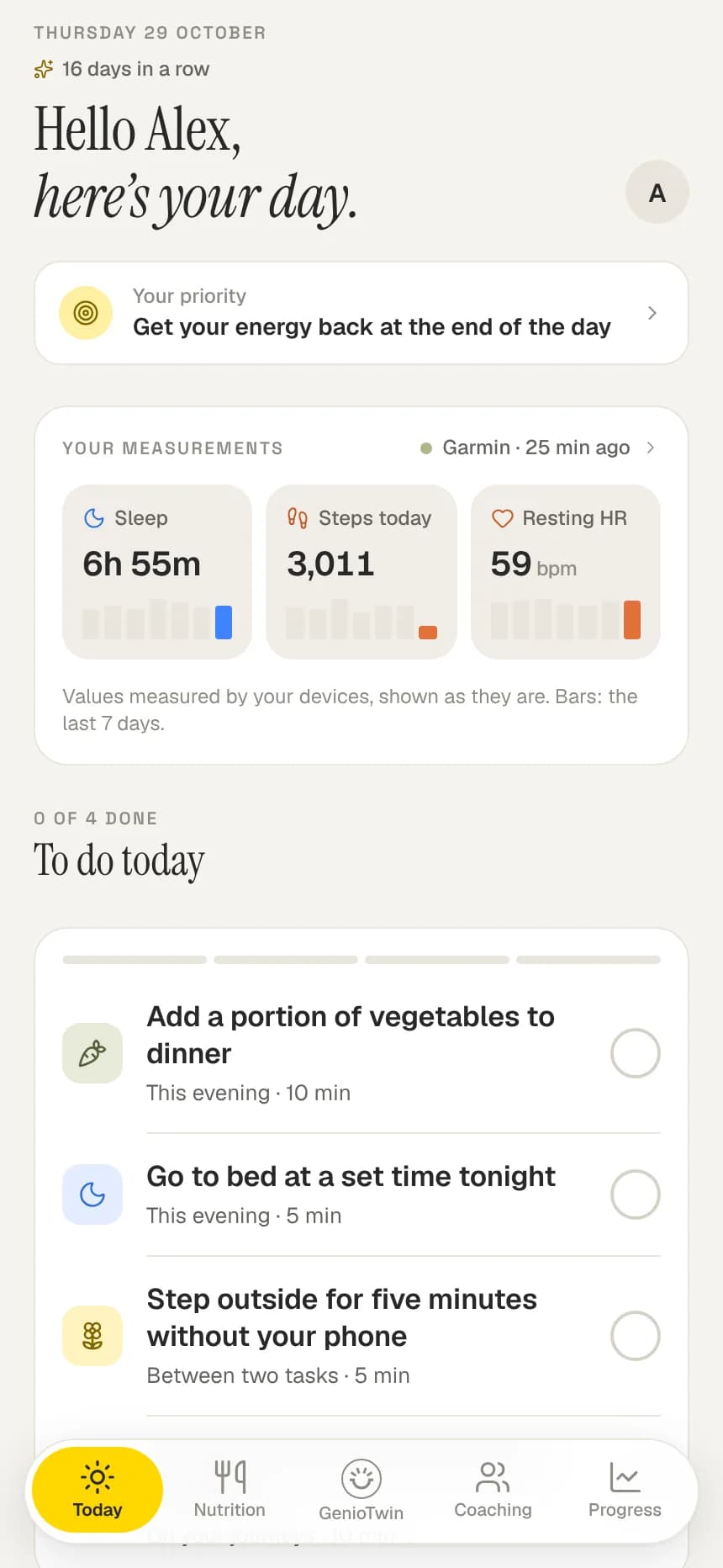
Through GenioTwin, your personal artificial intelligence assistant, Genio connects the information you choose to share: your habits and goals, your blood test results, certain biological tests and data from your connected devices. In this way, the different pieces of the puzzle begin to make sense within a more complete picture of your well-being.
But knowing your body is only the beginning. What matters is knowing what to do with that knowledge.
From recommendations to your everyday life
Imagine you get home after a busy day. You want a balanced dinner, but you have neither the time nor the inclination to decide what to make.
You can look up which recipes best suit your goals and preferences and cook them yourself, or choose the subscription that includes having dishes prepared by our chefs delivered straight to your home.
And nutrition is only one part of the experience. Genio also helps you build habits around physical activity, rest and mental well-being, taking your circumstances and priorities into account.
Genio ScoreExample
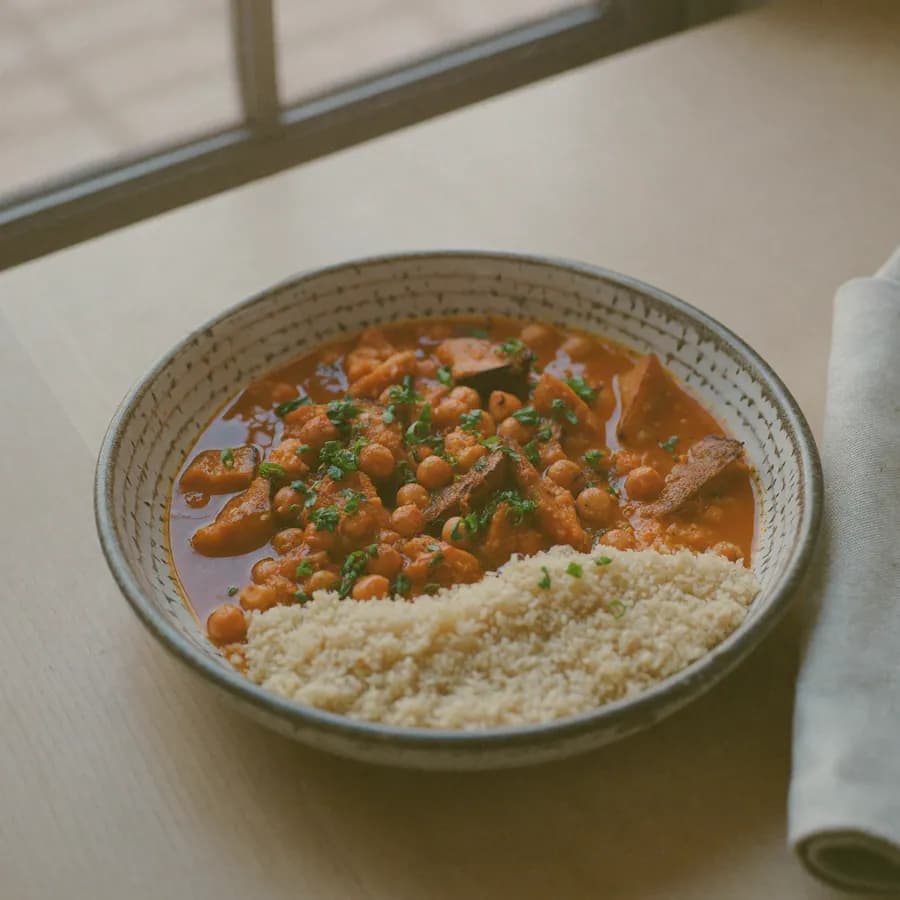
Red chickpea and squash curry with millet
- Eating better
- Stress management
- Energy
- Digestive comfort
Scores calculated for each goal from the dish’s composition. The Genio Score helps you choose: it does not predict the effect of a dish on your body.
- NutritionRecipes to cook or dishes from our chefs, depending on your goals.
- Physical activitySmall actions that fit into your week.
- SleepHabits to help you rest better, at your own pace.
- Mental well-beingMoments to breathe and take a break.
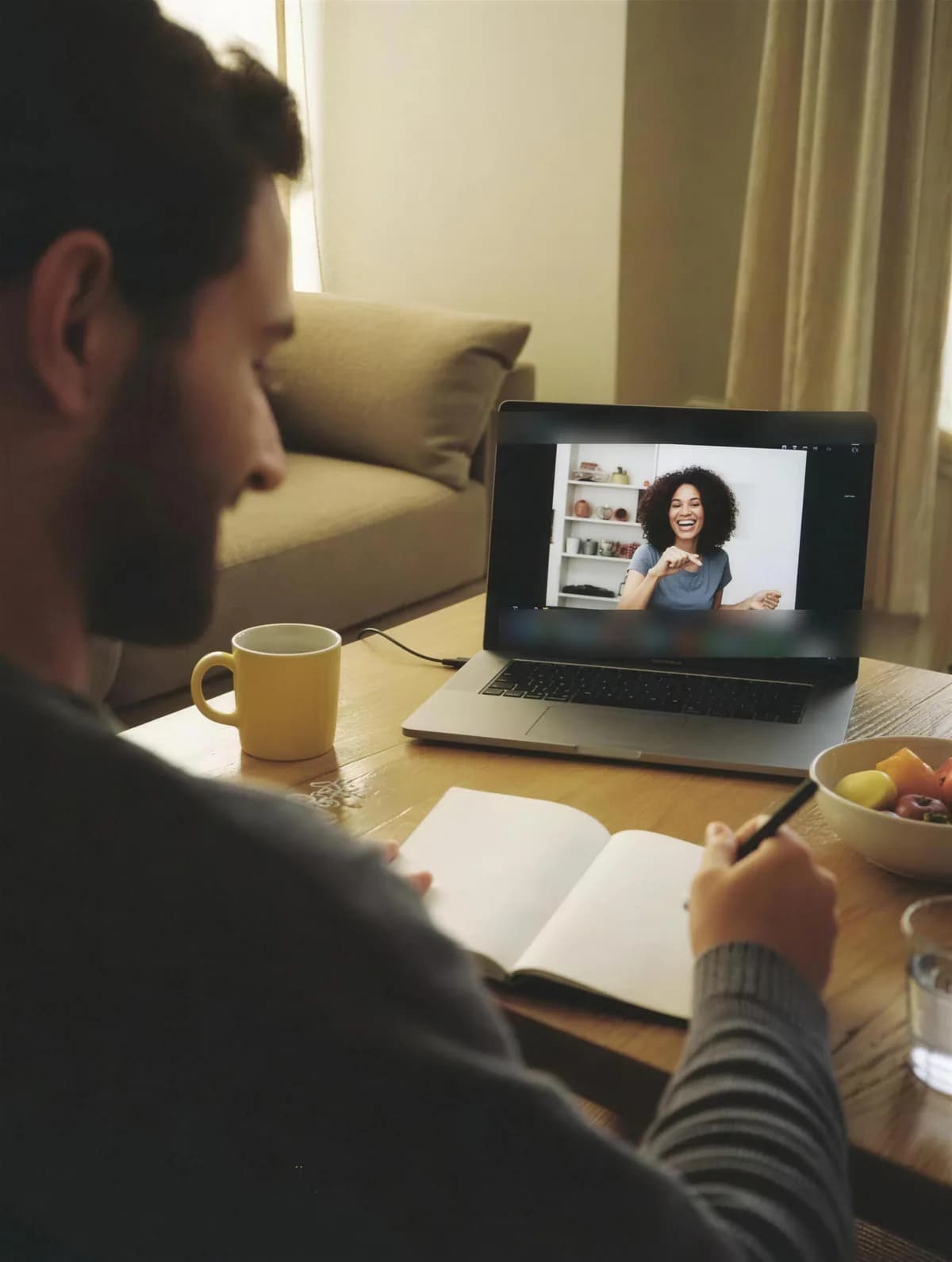
Human support
Digital tools and professional support, depending on the programme you choose.
So you don’t just receive recommendations: you have tools and services that help you put them into practice.
A plan that evolves with you
Your body changes, your circumstances change and your goals may change too. That’s why your well-being strategy shouldn’t stand still.
Genio lets you follow how you’re evolving, see your progress and review your priorities as you go. The information that comes from your habits, your connected devices and the assessments you do can help identify what is working and what is worth adjusting.
At first, your priority might be to get your energy back; later on, you may want to build muscle, improve your performance or focus on your long-term well-being. Or perhaps a change in schedule, a new stage of life or a different personal situation will lead you to rethink your habits.
Genio is designed to support you on that journey, adapting its recommendations as your needs and goals evolve, with digital tools and professional support depending on the programme you choose.
Knowing what you need, having help to put it into practice and seeing your progress. That is the experience we want to offer you with Genio.
Your well-being is personal. The way you look after it should be too.
Getting to know yourself better, making informed decisions and building good habits shouldn’t become yet another never-ending task. Genio was created to help you simplify that path: connecting the information that is relevant to you, turning it into tailored recommendations and supporting you so you can apply them, see your progress and evolve over time. Because the aim isn’t to devote your life to looking after yourself, but to look after yourself better so you can enjoy it more.
Want to see how Genio can help you reach your goals?
Have questions? Our virtual assistant can answer them, or you can contact our team directly. Write to our team
Appendix
Bibliography
Every study cited was opened and checked; the links lead to the original publication.
Keep this guide
The same guide as a PDF, to read offline or share.
Studies cited in the chapters
- 2. Chapter 1 · SleepTasali E, Wroblewski K, Kahn E, Kilkus J, Schoeller DA. Effect of Sleep Extension on Objectively Assessed Energy Intake Among Adults With Overweight in Real-life Settings: A Randomized Clinical Trial. JAMA Internal Medicine. 2022;182(4):365-374.doi.org/10.1001/jamainternmed.2021.8098
- 4. Chapter 2 · MuscleKennis E, Verschueren S, Van Roie E, Thomis M, Lefevre J, Delecluse C. Longitudinal impact of aging on muscle quality in middle-aged men. Age. 2014;36(4):9689.doi.org/10.1007/s11357-014-9689-1
- 5. Chapter 2 · MenopauseGreendale GA, Sternfeld B, Huang M, et al. Changes in body composition and weight during the menopause transition. JCI Insight. 2019;4(5):e124865.doi.org/10.1172/jci.insight.124865
- 8. Chapter 3 · EpigeneticsHorvath S. DNA methylation age of human tissues and cell types. Genome Biology. 2013;14(10):R115.doi.org/10.1186/gb-2013-14-10-r115
- 9. Chapter 3 · EpigeneticsLei MK, Gibbons FX, Simons RL, Philibert RA, Beach SRH. The Effect of Tobacco Smoking Differs across Indices of DNA Methylation-Based Aging in an African American Sample: DNA Methylation-Based Indices of Smoking Capture These Effects. Genes. 2020;11(3):311.doi.org/10.3390/genes11030311
- 10. Chapter 3 · EpigeneticsFox FAU, Liu D, Breteler MMB, Aziz NA. Physical activity is associated with slower epigenetic ageing: Findings from the Rhineland study. Aging Cell. 2023;22(6):e13828.doi.org/10.1111/acel.13828
- 12. Chapter 3 · Vitamin DRevez JA, Lin T, Qiao Z, et al. Genome-wide association study identifies 143 loci associated with 25 hydroxyvitamin D concentration. Nature Communications. 2020;11(1):1647.doi.org/10.1038/s41467-020-15421-7
- 13. Chapter 3 · MicrobiotaSo D, Whelan K, Rossi M, et al. Dietary fiber intervention on gut microbiota composition in healthy adults: a systematic review and meta-analysis. The American Journal of Clinical Nutrition. 2018;107(6):965-983.doi.org/10.1093/ajcn/nqy041
- 14. Chapter 4 · HabitsGollwitzer PM, Sheeran P. Implementation Intentions and Goal Achievement: A Meta-analysis of Effects and Processes. Advances in Experimental Social Psychology. 2006;38:69-119.doi.org/10.1016/S0065-2601(06)38002-1
- 15. Chapter 4 · HabitsLally P, van Jaarsveld CHM, Potts HWW, Wardle J. How are habits formed: Modelling habit formation in the real world. European Journal of Social Psychology. 2010;40(6):998-1009.doi.org/10.1002/ejsp.674
Studies cited in the “Did you know?” boxes
- 1. Introduction · GlucoseZeevi D, Korem T, Zmora N, et al. Personalized Nutrition by Prediction of Glycemic Responses. Cell. 2015;163(5):1079-1094.doi.org/10.1016/j.cell.2015.11.001
- 3. Chapter 1 · CaffeineDrake C, Roehrs T, Shambroom J, Roth T. Caffeine Effects on Sleep Taken 0, 3, or 6 Hours before Going to Bed. Journal of Clinical Sleep Medicine. 2013;9(11):1195-1200.doi.org/10.5664/jcsm.3170
- 6. Chapter 2 · StepsLee IM, Shiroma EJ, Kamada M, Bassett DR, Matthews CE, Buring JE. Association of Step Volume and Intensity With All-Cause Mortality in Older Women. JAMA Internal Medicine. 2019;179(8):1105-1112.doi.org/10.1001/jamainternmed.2019.0899
- 7. Chapter 2 · StepsPaluch AE, Bajpai S, Bassett DR, et al. Daily steps and all-cause mortality: a meta-analysis of 15 international cohorts. The Lancet Public Health. 2022;7(3):e219-e228.doi.org/10.1016/S2468-2667(21)00302-9
- 11. Chapter 3 · TwinsFraga MF, Ballestar E, Paz MF, et al. Epigenetic differences arise during the lifetime of monozygotic twins. Proceedings of the National Academy of Sciences. 2005;102(30):10604-10609.doi.org/10.1073/pnas.0500398102
- 16. Chapter 4 · WalkingBuffey AJ, Herring MP, Langley CK, Donnelly AE, Carson BP. The Acute Effects of Interrupting Prolonged Sitting Time in Adults with Standing and Light-Intensity Walking on Biomarkers of Cardiometabolic Health in Adults: A Systematic Review and Meta-analysis. Sports Medicine. 2022;52(8):1765-1787.doi.org/10.1007/s40279-022-01649-4
Source 1
Zeevi D, Korem T, Zmora N, et al. Personalized Nutrition by Prediction of Glycemic Responses. Cell. 2015;163(5):1079-1094.
Source 2
Tasali E, Wroblewski K, Kahn E, Kilkus J, Schoeller DA. Effect of Sleep Extension on Objectively Assessed Energy Intake Among Adults With Overweight in Real-life Settings: A Randomized Clinical Trial. JAMA Internal Medicine. 2022;182(4):365-374.
Source 3
Drake C, Roehrs T, Shambroom J, Roth T. Caffeine Effects on Sleep Taken 0, 3, or 6 Hours before Going to Bed. Journal of Clinical Sleep Medicine. 2013;9(11):1195-1200.
Source 4
Kennis E, Verschueren S, Van Roie E, Thomis M, Lefevre J, Delecluse C. Longitudinal impact of aging on muscle quality in middle-aged men. Age. 2014;36(4):9689.
Source 5
Greendale GA, Sternfeld B, Huang M, et al. Changes in body composition and weight during the menopause transition. JCI Insight. 2019;4(5):e124865.
Source 6
Lee IM, Shiroma EJ, Kamada M, Bassett DR, Matthews CE, Buring JE. Association of Step Volume and Intensity With All-Cause Mortality in Older Women. JAMA Internal Medicine. 2019;179(8):1105-1112.
Source 7
Paluch AE, Bajpai S, Bassett DR, et al. Daily steps and all-cause mortality: a meta-analysis of 15 international cohorts. The Lancet Public Health. 2022;7(3):e219-e228.
Source 8
Horvath S. DNA methylation age of human tissues and cell types. Genome Biology. 2013;14(10):R115.
Source 9
Lei MK, Gibbons FX, Simons RL, Philibert RA, Beach SRH. The Effect of Tobacco Smoking Differs across Indices of DNA Methylation-Based Aging in an African American Sample: DNA Methylation-Based Indices of Smoking Capture These Effects. Genes. 2020;11(3):311.
Source 10
Fox FAU, Liu D, Breteler MMB, Aziz NA. Physical activity is associated with slower epigenetic ageing: Findings from the Rhineland study. Aging Cell. 2023;22(6):e13828.
Source 11
Fraga MF, Ballestar E, Paz MF, et al. Epigenetic differences arise during the lifetime of monozygotic twins. Proceedings of the National Academy of Sciences. 2005;102(30):10604-10609.
Source 12
Revez JA, Lin T, Qiao Z, et al. Genome-wide association study identifies 143 loci associated with 25 hydroxyvitamin D concentration. Nature Communications. 2020;11(1):1647.
Source 13
So D, Whelan K, Rossi M, et al. Dietary fiber intervention on gut microbiota composition in healthy adults: a systematic review and meta-analysis. The American Journal of Clinical Nutrition. 2018;107(6):965-983.
Source 14
Gollwitzer PM, Sheeran P. Implementation Intentions and Goal Achievement: A Meta-analysis of Effects and Processes. Advances in Experimental Social Psychology. 2006;38:69-119.
Source 15
Lally P, van Jaarsveld CHM, Potts HWW, Wardle J. How are habits formed: Modelling habit formation in the real world. European Journal of Social Psychology. 2010;40(6):998-1009.
Source 16
Buffey AJ, Herring MP, Langley CK, Donnelly AE, Carson BP. The Acute Effects of Interrupting Prolonged Sitting Time in Adults with Standing and Light-Intensity Walking on Biomarkers of Cardiometabolic Health in Adults: A Systematic Review and Meta-analysis. Sports Medicine. 2022;52(8):1765-1787.